

Light in the World
On minimalism, meaning, and moving internationally

I think all of us, at some point, wonder what our lives mean.
Luckily, the internet can answer that question for me. (That was sarcasm.)
The List made a video about my life. For a moment, I had to double-check to see if I had died in some Beetlejuice-type situation because it really felt like a post-mortem retrospective.
And then there are the hilarious comments —
(you can hear my husband yelling, DON’T READ THE COMMENTS from across the room right now)
— they say stuff like this:
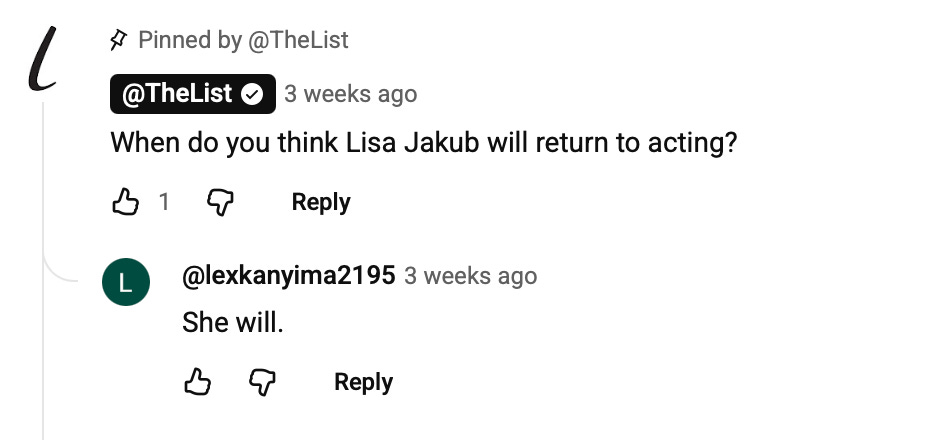
I’m impressed that random internet people have so much more confidence in my life path than I do. I picture @lexkanyuma2195 squinting slightly and giving a subtle head nod. “She will return,” they say with grounded self-assurance. “Maybe not today, maybe not tomorrow…but she will.”
So I cringe-watched this video about my life, and then I was startled by its abrupt ending.
Like, it just ended.
So, now what?
That familiar panic rose up in me, that feeling of being constantly oriented to what’s next.
In fairness, it’s a valid question. What’s next — is that I’ve moved to Canada with my husband and dog, only taking the possessions that would fit in our car, and we are starting a new chapter with a hell of a lot of blank pages. I am calling it a Gap Year and being very intentional about the work I do.
I know only one thing with the staggering confidence of @lexkanyuma2195. And that is that I want to be light in the world right now.
It’s a phrase that sings in the back of my mind. And I’m only starting to figure out what it means.
I want to be light in the world.
I want to be light in the world.
I want less. I want to have less, do less, consume less, worry less.
It’s a psychological challenge, packing a car with two people, a dog, and everything you own, then driving to another country. It’s complicated to sell your house and leave the community you have lived in for 20 years. It poses not only a logical challenge — How do I register for healthcare? What do I do in a country where I have a credit score of zero? But it poses a challenge that strikes even deeper — Who am I, if I am not defined by the work that I do? Who am I, if I don’t own a house and two hundred books and all the other indicators I’ve been told make up a successful grown-up life?
The desire to fill that space by filling an online cart with random shit is shockingly strong.
The psychology of consumerism is well-documented. I’ve never particularly enjoyed shopping, but even I notice the dopamine rush from getting something on sale or waiting for a delivery. It’s a tiny spark that seems to soothe the soul for a moment before returning to laundry or groceries or making the bed or flossing my teeth. But there is a significant toll for that spark. Documentaries like Buy Now: The Shopping Conspiracy show the dark side of all that stuff, and it’s honestly stomach-churning.
Getting rid of 80% of our belongings was, on the whole, much easier than I expected, likely because it felt so purposeful. There is no moral superiority here. I’m not saying this lean towards minimalism is right for everyone; I’m not even sure this is right for me forever. But this lightness feels really good in this moment.
Everything I shed was a reminder that those things didn’t define me. It felt like I was peeling off dried mud, letting it flake into dust, and exploring new ways to stretch and move now that I have the flexibility of what was underneath.
(I want to be light in the world)
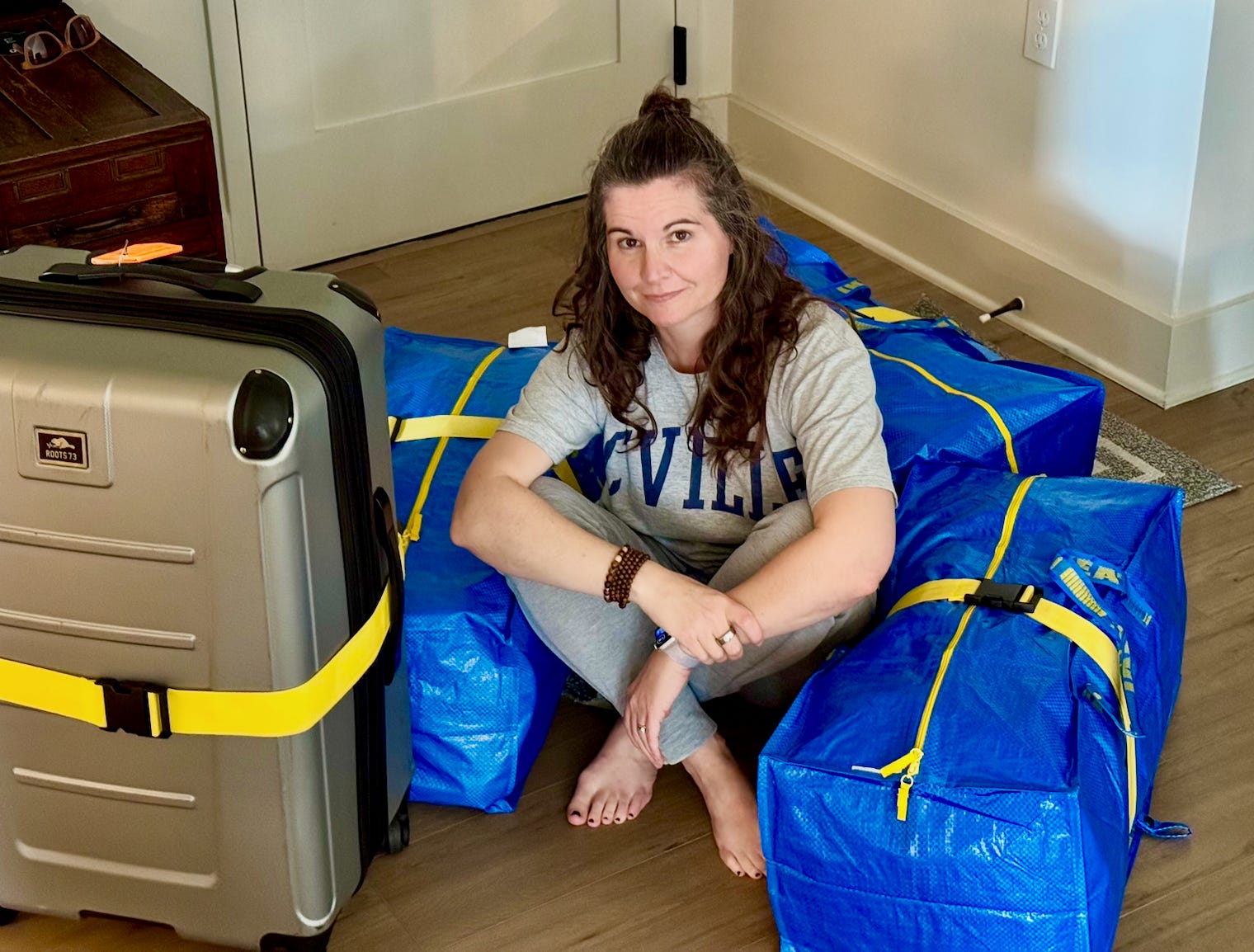
Even if giving most of our possessions away was easier than expected, as someone who personifies everything and buys the dented cans at the grocery store because she feels bad for them — there were certainly emotional moments.
I shredded dozens of journals, which contained the painful memories, grief, loss and disappointments that had shaped me and informed who I am, regardless of whether I carried the paperwork to prove it.
We were gifted twelve purple champagne glasses from our wedding registry 21 years ago, because I thought I’d be a wife who hosted posh champagne brunches, even though I hate hosting because it makes me anxious to have people in my space, and I have never been good at alcohol.
There was the ten-year-old couch with the slightly dented cushions. We bought that couch because it was the same colour as our elderly rescue dog, so we figured the dog hair wouldn’t show as much. And then three years later, our dog took her last breath on that couch, wrapped in her favourite blanket. We sang to her and held her, and our sweet veterinarian was crying too, as she injected the needle.
That memory stayed, even as the couch was carried away to the donation place.
There was the Vitamix blender, the library lamp, the ergonomic desk chair, and the yoga bolster that went to my friend who was setting up a new home with her partner. There was the large snake plant I hand-delivered to another friend in Pennsylvania, who I knew would not only keep it alive, but also refer to the plant by his given name, which is Kaa.
I don’t need the pile of rubber bands that once wrapped stalks of asparagus, or the astonishing 21 travel mugs (of which I only recall buying three; the others seem to have bred in the cupboard), or the Epsom salts that I accidentally bought in a scent that makes me sneeze. I don’t need the dresses I bought back when we were all still concerned about Y2K. I had kept gifts, even though they were not suitable, and put them in a closet, I guess, so I could just feel bad about them all over again, later? Everything went to friends or donation centers, and after every car-load left, I marvelled at the lightness in my shoulders.
(I want to be light in the world)
Days before our move, I stood in our living room with a gigantic pile of linens on the floor. Coca-Cola towels that were part of a giveaway when my cousin won us a trip to Club Med Mexico in 1998, tea towels from a quaint European town (was it in Italy or France?), enough hand towels to supply a family of ten octopuses, lumpy washclothes I knit, and I’m a terrible knitter who can only make flat things, poorly. An unreasonable number of pillows and pillowcases were scattered around, because I need to be ready if fifteen guests show up and want a pillow fight.
Ann Patchett wrote about getting rid of stuff in her lovely New Yorker article How to Practice: I wanted to get rid of my possessions, because possessions stood between me and death.
“I had miscalculated the tools of adulthood when I was young, or I had miscalculated the kind of adult I would be.”
I had definitely miscalculated something.
I stared at the linens and felt panic rise up. I sat on the floor, planting my palms into my eye sockets. Why did I have so much? I knew I was complicit in acquiring it all, but how had it happened and why?? I don’t need this. I felt glutinous, sick to my stomach, like I had eaten an entire pizza by myself. I felt heavy and suffocated, like I was desperately clawing my way to the surface of something. I never wanted to feel like that again. I wanted a clean slate. I wanted to bring into my home only the things that most belonged there. Things that were intentional and right-sized for the life I wanted.
Our local animal shelter got lots of linens to cuddle up their animals that day, and I felt something break, but in a good way.
I went searching for others who had experienced something similar, and I came across this by Sherry Ning:
“Standing in front of all my stuff, it hit me that all of it used to be money, and all of that used to be time. I was standing in front of the metabolic waste of my existence, materialized. I was looking at the amount of my time, therefore my life, that had been turned into garbage. And the worst part is that I could’ve prevented it.”
This comes from a beautifully inflammatory article titled, “You’re Overspending Because You Lack Values” and it’s worth a read.
Those towels represented the time I spent working, away from my family, worrying at 3 AM about books, speeches, workshops, interviews, and online content. And even further back, to my film career, all that travel and missing out on proms and graduations. To get the maximum-level hippie-dippie about it, those towels represented my life force, crumpled up there on the floor. And I want my life to mean more than lumpy washclothes.
I want to right-size my own consumption, and I’m not sure what that looks like yet. I know my 850-square-foot apartment is now easier to manage, easier to clean, easier to find things. It feels simple and light.
(I want to be light in the world)
Since our dishes didn’t fit in the car when we moved to Canada, we bought a place setting for four people when we arrived, because we are just two people, which seemed like enough. Every night, our four plates, four bowls, glasses and mugs (I constantly have three beverages going at a time), dog bowls, cooking utensils, the cutting board, and the kitchen sponge go in the dishwasher. We set it for 1/2 load and run it every night. And each morning we start over fresh — with just enough.1
I say this with full recognition that THIS IS NOT AN INTERESTING STORY ABOUT PLATES. Who the fuck cares about my dishwashing system? The point is that I am now reassessing everything I thought I needed. I’m doing this with plates, relationships, and work. I’m doing this with absolutely everything that I let into my life.
Do I actually need that?
Do I actually want that?
There are things that get a resounding “yes.” This is not about depriving myself so I can win at minimalism. I bought the cutest pair of boots the other day. Because I needed them, I wanted them, and they brought me joy.
I don’t miss the four extra bottles of soy sauce that expired before we could use them. I don’t miss the drawer full of keys that were never labeled so no one knows what they unlock. I don’t miss the shirt that I got on sale for so cheap it was almost free, but when I put it on, it looked like something that was so cheap it was almost free. I don’t miss the hard drives containing three drafts of the college paper I wrote on the impact of the Truth and Reconciliation Commission post-Apartheid.
The things that do matter are now in the foreground of my life. My grandmother’s necklace. Twelve of my absolute favorite books. The small beaded rhino we got in Cape Town. The singing bowl from Chang Mai. The handmade mug we bought from the potter at the farmer’s market that feels so good in my hands. The Mrs. Doubtfire original script, signed by all the cast members. And I can actually see all that now, because all the hotel shampoos and mini muffin tins aren’t in the way.
Minimalism opens up a whole world of other things I can get rid of. Like the feeling that I’m never doing enough. Or the people pleasing. Or the incessant worrying about things beyond my control. Or the harsh criticisms I often use against myself.
All that seems even less useful than all those old iPhone chargers.
(I want to be light in the world)
It’s easier to let go of the physical clutter, but I’m learning. When it comes to the pursuit of happiness, maybe the problem lies in the pursuit itself. The pursuit of more, more money, more stuff. Maybe the happiness is already here, hidden behind the four bottles of expired soy sauce.
Maybe if I remove the pursuit, what’s left is just happiness.
Comments are open if you’d like to say hi. Thank you for reading.
Ramit Sethi calls this his “1-2-3 System” (loading, running, unloading), and I love that my favourite financial nerd has a dishwasher system.
Hi Lisa. I'm very glad to have found you here - via LinkedIn! - of all places, which is unusual because I almost never check in with them. Having heard "rumors" of your move, I still was curious: wondering about the why's, wherefores, and where you landed. So glad you are in Canada and feeling well there. I always thought of you as a light in the world and now appreciate the lightness of your footprint on the planet. I have a feeling you will be showing up in the collective consciousness as an ambassador of light, lightness, and just simple joy. All the best to you and the family. Hélène
Well, I suppose this is just 'saying hi'..
I have never seen Mrs Doubtfire, which might put me in the same small segment of humanity who have never read a Harry Potter novel or who have grown up in an underground bunker in the desert somewhere. But what I did watch, last year, was the film 'Matinee', where I was totally blown away by the girl who refused to duck and cover with Bert the Turtle. I looked up who she was, found she'd also been in the short 'George Lucus and Love' which I also watched and loved. They may not be globally famous films, but they're pretty much perfect. So I started reading your substack, which I really enjoy.
Is there a link between the real woman who packed everythign into a car and moved to a different country, and a fictitious girl who said frankly if there was a nuclear strike she did not want to survive it? Who knows, maybe....